A thatch roof asks for very little, but it does ask. The owners whose roofs quietly pass thirty years are not lucky: they are the ones who give the roof an hour of attention twice a year instead of waiting for a leak to force the issue. Here is what thatch roof maintenance actually looks like on a Cape Town home, season by season, and which jobs are worth leaving to a thatcher.
Why maintenance is the cheapest money you will spend
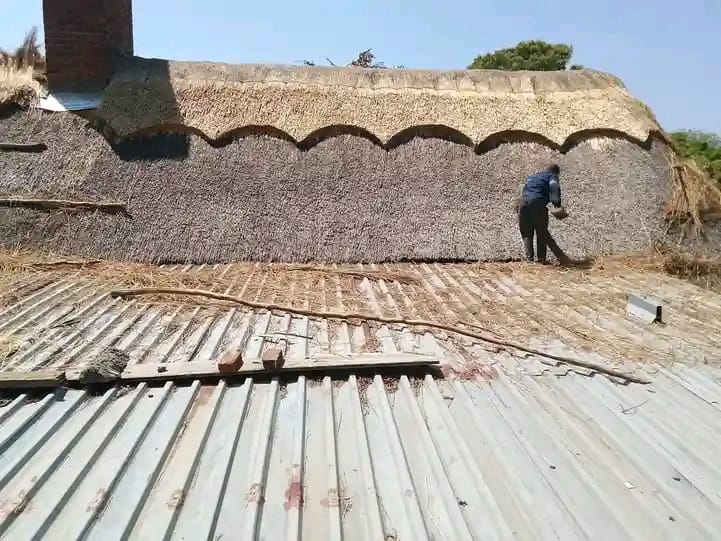
The ridge fails first on almost every roof: it takes the wind and holds the fixings, and once it opens, water runs into the body of the thatch instead of over it. A roof that is combed, has its valleys cleared and its ridge checked every couple of years will comfortably outlast a neglected one by a decade. None of that is expensive. Ignoring it is.
Thatch roof maintenance: the twice-a-year check
Twice a year: once after the summer south-easters have died down, once before the winter rain sets in: walk around the house and look up. You are checking for:
- A ridge that looks dark, sagging or soft, rather than tight and even.
- Valleys and gutters clogged with oak leaves or pine needles, which hold water against the reed.
- A thick green mat of moss on the shaded or south-facing slope.
- Loose reed collecting on the paving below: a sign the surface is loosening.
- Any glimpse of fixing wire or batten tips, which means that slope is getting thin.
A Cape Town year, season by season
Summer: the south-easter scours the exposed slope: keep an eye on the windward face, as it ages fastest. Autumn: clear every valley and gutter of leaves before the first front arrives; this one job prevents most winter leaks. Winter: after heavy rain, check the ceilings for fresh damp patches and the ridge for sag. Spring: the time to book a proper comb-and-clean, and to re-apply fire-retardant if you are due: see our note on thatch fire safety and compliance for how that cycle works.
What to do yourself, and what to leave to a thatcher
You can safely do the ground-level work: clearing leaves from valleys, cutting back branches that overhang and shade the roof, and keeping an eye on the ridge and ceilings. What you should not do is walk on the thatch: it crushes the reed and does more harm than the problem you went up to fix. Combing, ridge work, moss treatment and anything that needs someone on the roof is a thatcher’s job, done off a ladder or scaffold.
A simple rule: if the fix involves standing on the roof, phone someone. If it involves standing on the ground, it is probably yours to do.
Keep a maintenance rhythm
Budget for a ridge rebuild somewhere around year twelve to fifteen: it is a fraction of a re-thatch and the single best money you will spend on the roof. If a check turns up more than surface wear, our guide to thatch roof repairs in Cape Town covers what the common fixes cost, and if you are wondering how much life is left in the roof at all, how long a thatch roof lasts here gives you a realistic number.
If you would rather not climb ladders and guess, we handle maintenance visits across the Cape. See our thatching services, take a look at our recent projects, or book a maintenance inspection and we will give the roof an honest once-over.
Season by season in Cape Town
Autumn, March to April. The most important visit of the year. Check and repair the ridge before the winter rain, clear moss from the shaded slope, cut back overhanging branches, and clear gutters and valleys so water cannot back up.
Winter, May to August. Watch rather than work. Look at ceilings after heavy fronts, note where any damp appears, and photograph it. Wet thatch is not the time for roof work unless something has failed.
Spring, September to October. Bird season. Check the eaves and ridge for nesting activity and deal with it early, before a colony thins a slope.
Summer, November to February. The dry window for any real work: brushing, ridge replacement, treatment reapplication. Also the season the south easter works at loose material, so a post-summer check is worthwhile.
What a maintenance visit actually includes
A proper visit is not a look from the driveway. We check thickness and density on each slope, inspect the ridge closely, look at every junction and penetration, check fixings for corrosion, and go inside with a torch to look at the underside of the thatch and the timbers.
You should get photographs and a plain statement of what needs doing now, what can wait a year, and what is simply worth watching. That record is also useful for your insurer, who would rather see a dated condition report than take your word for it.
Related reading: cleaning a thatch roof, thatch roof pests and thatch roof storm damage.
Frequently asked questions
What maintenance does a thatch roof need?
Twice yearly inspections, ridge attention when it wears, brushing every three to five years, moss clearing, and cutting back overhanging branches.
How often should a thatch roof be inspected?
Twice a year is the practical standard: once before winter and once after the windy season. That catches most faults while they are still cheap.
Can I maintain a thatch roof myself?
You can clear gutters, cut back branches and watch for changes from the ground. Anything involving the roof surface should be left to a thatcher, since walking on thatch breaks the water path.
Does maintenance really extend thatch roof life?
Considerably. Roofs that quietly pass thirty years are almost always the maintained ones. A ridge replaced on time protects decades of thatch beneath it.
Want a straight answer on your own roof?
Free inspections across Cape Town and the Winelands. We’ll give you the number, the photos and the options: no pressure to book anything.