Ask is a thatch roof waterproof and the honest answer is no, not in the way people mean. A tile or a membrane is a barrier. Thatch is not a barrier at all. It is a shedding system, and once you understand the difference, almost every thatch problem and thatch myth makes sense.
Is a thatch roof waterproof? It sheds, it does not block
Reed or grass stems are laid in overlapping courses, packed tightly, and pitched steeply. Rain hits the outside of the stems and runs down the outside, course to course, until it drops off the eaves. It never travels through the roof because it never gets the chance to travel inward.
In normal Cape Town rain only the top 30mm to 50mm of a 200mm thatch roof ever gets wet. The rest stays dry. After the rain, the wet layer dries outward in the wind and sun. That wetting and drying cycle is normal and healthy. It is how thatch has worked for centuries.
The three things that make it work
Pitch. This is the big one. Thatch needs roughly 45 degrees to shed properly. Shallower than that and water lingers on the stems long enough to soak inward. You cannot fix an under-pitched thatch roof with better material or more of it. See why 45 degrees matters.
Density. Loosely laid thatch has gaps between stems. Water finds gaps. A properly dressed roof is compacted hard enough that the stems act as one surface.
Detailing. Ridges, valleys, hips and anywhere the roof meets a wall or a chimney. These are the points where the simple downhill water path is interrupted, and they are where nearly all leaks begin.
So why does my thatch roof leak?
Because one of those three failed. The ridge wore out, the body thinned so the stems no longer act as one surface, a valley was badly formed, or the pitch was wrong from day one.
Age alone does not cause leaks. We have inspected forty-year-old reed roofs still shedding perfectly and eight-year-old roofs leaking at every junction because the detailing was rushed. Our guide to thatch roof leaks covers diagnosis.
Why sealing thatch makes it worse
This follows directly from how thatch works. If the top layer gets wet in every storm and dries afterward, then anything that stops it drying is harmful. A sealer or waterproofing spray forms a film that holds that moisture inside the thatch instead of letting it evaporate.
The roof looks treated and protected. Underneath, the wet layer never dries, and the material rots from within. We have stripped sealed roofs where the outer 50mm was soft and black while the untreated roof next door was sound. Read the full explanation in do thatch roof sealers work.
What about very heavy rain?
A sound thatch roof handles Cape winter fronts without trouble. What it does not handle well is wind-driven rain hitting a slope at an angle the roof was not designed for, combined with an already thin body of thatch. Storm leaks are usually a pre-existing weakness being exposed rather than the storm defeating good thatch.
Our guide on thatch roof storm damage covers what to check before winter.
Practical implications for owners
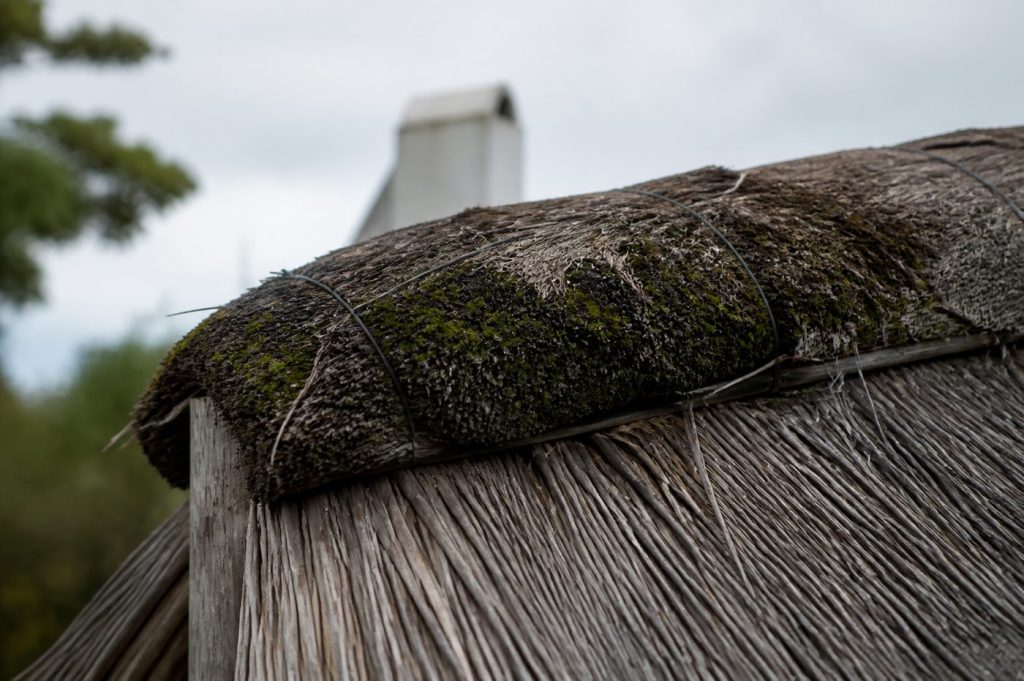
Keep the water path clean. Overhanging branches drop debris that dams water on the slope. Moss on the shaded side holds moisture against the thatch. Satellite dishes and vents fitted through the thatch interrupt the shedding path and need proper flashing detail.
Keep the ridge maintained, because the ridge is the one place where there is no upslope thatch protecting the layer below. And get the roof looked at twice a year rather than after the first drip appears. Our maintenance guide sets out the routine.
What this means when you get a quote
Because thatch works by pitch, density and detailing, those three things are what a quote should describe. A quote that names a material and a price but says nothing about thickness, dressing or how the ridge and valleys will be formed is not telling you whether the roof will shed water.
Ask what thickness will be laid. Ask how the valleys will be formed, and specifically whether they will be swept rather than cut and filled. Ask what the ridge detail is. These are the answers that separate a roof that lasts thirty years from one that leaks in five.
Why old thatch roofs still work
Thatch predates every modern waterproofing product and it kept people dry for centuries without any of them. That is worth remembering when someone offers to improve your roof with a coating or a membrane. The system already works. What it needs is to be built at the right angle, packed hard enough, detailed properly at the junctions, and maintained. Our guides on thatch roof leaks and how long a thatch roof lasts in Cape Town cover both halves of that.
Frequently asked questions
Is a thatched roof waterproof?
Not in the sense a tile roof is. Thatch sheds water down the outside of tightly packed stems at a steep pitch rather than acting as a barrier. Only the top few centimetres get wet in normal rain.
How does a thatched roof keep out the rain?
Through pitch, density and detailing. Roughly 45 degrees of pitch makes water run off before it can soak in, tight packing stops it finding gaps, and correct ridge and valley detailing keeps the water path unbroken.
Can rain leak through a thatched roof?
Only when something has failed: a worn ridge, thatch that has thinned, a poorly formed valley or a pitch that is too shallow. Sound thatch at the right pitch does not leak.
Should I waterproof my thatch roof?
No. Thatch has to dry out between rains. Sealers trap moisture inside the material and cause rot. Maintain the ridge, density and detailing instead.
Want a straight answer on your own roof?
Free inspections across Cape Town and the Winelands. We’ll give you the number, the photos and the options: no pressure to book anything.